Tuesday, June 28, 2011

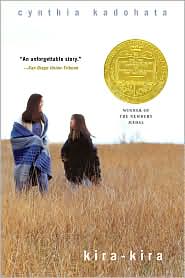
Review #5 Kira-Kira


Kadohata, Cynthia. Kira-kira. New York: Atheneum for Young Readers, 2004. Print.


Annotation:

Kira-Kira is a tragic yet touching story of a young Asian American girl and her and her families' struggle in America during the 1950's. Winner of the 2005 Newbery Medal, Cynthia Kadohata weaves a tale of bravery and trust as we watch Katie idolize and finally lose her older sister Lynn.


Justification for Nomination (genre Multicultural):

Kira-Kira is a nice change of pace because it is specifically meant for young teens, so the read is easy and fun. You feel like you are gaining a little bit of extra knowledge when you read it because of how the author sprinkles in Japanese words so you can learn them along the way. The reader feels compassion for Katie and people with siblings surely feel a connection with Katie and Lynn as sisters. It is very interesting reading about Japanese people in America in the 1950's because this was probably a hard time to be Japanese-American. Katie explains how they would approach a restaurant where there was segregation, and without knowing where they should sit, they would order to-go.

Kira-Kira is written in first person from the viewpoint of Katie, who is 11 years old at the end of the book. I think the author lets you get somewhat close to Katie but because she is a little girl her thoughts are plain and straightforward. Katie is not manipulative or cruel, or have evil thoughts. She thinks about how her father loving her mother makes her feel loved, and how she can eat as many candies as she wants because her teeth are baby teeth and will fall out anyway.

Overall the book was endearing, and definitely targeted for a younger audience. I think it was a bit sad but I enjoyed reading and learning some cultural tips about Japan along the way.

Friday, June 17, 2011

Review #4 Helmet For My Pillow: From Parris Island to the Pacific

Leckie, Robert. Helmet for My Pillow: from Parris Island to the Pacific : a Young Marine's Stirring Account of Combat in World War II. New York: Bantam, 2010. Print.


Annotation:

Truly compelling, Helmet for my Pillow is an intimate look at one young Marine's life from his training to his survival of some of the most epic battles in the Pacific Theater of World War II. Robert "Lucky" Leckie recalls the hardships of himself and his fellow Marines, and recounts in haunting detail the price they paid for serving their country when they were still only teenagers.


Justification for Nomination:

Set in the genre of General Non-Fiction, this book written by Robert Leckie is a heartfelt and incredible look into his time serving in the First Marine Corps of the United States. Helmet For My Pillow has been an impact on the motion picture industry as well, and is a big part of Tom Hank's HBO critically acclaimed mini-series "The Pacific" where Robert Leckie plays a main part in the story line as the first main character they introduce. The Pacific part of WWII is the less covered but just as amazing part of WWII, whereas many stories focus on Europe during that period, the fighting in the Pacific area was just as brutal if not more so. In Helmet For My Pillow the reader really feels the angst that Leckie goes through, it is first person and you travel with Leckie through his training and through the many battles he fought in and amazingly enough survived. The captivating part of the story isn't the combat, it's the hardships that Leckie and his fellow marines were forced to endure. Robert Leckie gives the full account of the malaria, dysentery and mental anguish he and his comrades dealt with while trying to stay positive. In the horrible conditions of Guadalcanal, the reader experiences alongside Leckie the foot sores and the sorrowful feeling of being "expendable" by the military. One of the most moving parts of this book is when Leckie's new commander moves him from H Company where his only friends are to the dispirited E Company, much to his humiliation and agony, and the reader really feels that the soldiers who are fighting an impenetrable force of Japanese are also cruelly fighting their own institution.

One moment which was endearing and also heartwarming was the uncertainty Leckie and his close friends encountered over whether or not their worth was even noticed by the United States, did their fellow American’s even know Guadalcanal even existed? This is one point where the book that was part of the material for the HBO miniseries The Pacific was entwined almost word-for-word. When they are pulled aboard a naval ship, too weak to even board the ship under their own strength, Leckie and his friends drink a cup of coveted coffee and speak with a seaman. The reader and the soldiers alike are taken aback and humbled when the naval man offers the fact that “Everyone has heard of Guadalcanal. You guys are heroes back home.”

One of the many things I can appreciate about the accounts taken by the men in The Pacific miniseries – Robert Leckie included – is the ability they have to retell the story without sounding unpatriotic or unappreciative. They recount the stories of being starved, shot at, dehydrated, and not having enough supplies to keep them healthy yet they speak of the Marine Corps as a thing of such pride and grace. They take it all in stride even on the brink of insanity, and do their best to make the most of their situation. Most of the men that Robert Leckie was friends with as well as himself were volunteers; they headed into WWII without even knowledge of if they would end up in Germany or in the Philippines.

Overall I thought this book was both compelling and engaging. The hardships and the triumphs are felt by both the soldiers and reader, and the injustice of the circumstances yet the heroism and courage of the men make it both infuriating and joyous. I wonder if this was a difficult piece to recall for the author, and by the way he distances himself from some of the men who were killed by referring to them loosely by their location or nationality makes me feel like this was an incredible feat not only to write a memoir about such a trying time but also to remember it all. I would recommend The Pacific miniseries to anyone as well as this book, and I am looking forward to reading other books written by Leckie as well as his comrades who have also written some pieces about the foreboding war fought in the Pacific.
Tuesday, June 14, 2011

Review #3 Whirligig

Fleischman, Paul. Whirligig. Laurel Leaf (November 9, 1999)


Annotation:
Brent Bishop desperately seeks the approval of his peers, but after being humiliated in front of everyone he considers important, Brent's life is spiraled into a mission of retribution. Ridden with guilt over taking a girl's life, he is set to the task of building four whirligigs on each corner of the United States. Whirligig takes you through a journey of five different sets of people, through their eyes and Brent's, defining the impact that his journey has on the lives of others.

Justification for nomination:
Since this book is so critically acclaimed, I almost feel a bit non-deserving to not put it up for nomination. This truly is a perfect example of how your life can intimately affect the lives of others, directly and indirectly. This book fits into the "Coming of Age" nomination category, where teens learn about the journey of another person and what they had ultimately learned. In this book we primarily follow Brent, who has killed a girl in a driving accident where he meant to take his own life. Brent realizes that he can still go on after the guilt has overcome him, and takes up the task set upon him by the girl's mother. Although that is an interesting part of the book, what I enjoyed most about this piece was the way the author conveyed that the lives of other people were changed by the whirligigs that Brent had created. There are several chapter which break way from the main story at different points and not in sequence, showing how the whirligigs impacted someone who came across where Brent had left them.

The writing style is third person, but doesn't leave you disconnected from the characters in the book unless the author specifically means to. I think that the author lets the reader get closer to Brent than to some of the other characters, since he is the central focus. The narrative voice is very descriptive in some cases and paints a picture of where the character is at any given time, it makes it effortless to picture the campsite with the red picnic table that Bret spends time at. It is sad to see Brent change from a kid who just wants the pretty girl at school to like him to a 17-year old veteran of travel who will not admit to anyone why he the accidental death of the girl he hit took place, but when I finished the book I thought that there really are people who have had this happen to them, and a struggle to re-identify yourself after guilt has taken a hold is a definitely not something to be taken lightly.

Tuesday, June 7, 2011

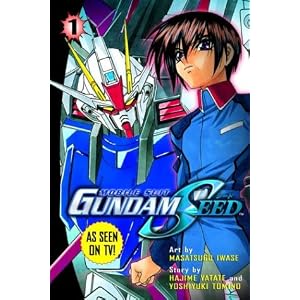
Review #2 Mobile Suit Gundam Seed

Hajime Yatate, Del Rey; First Edition edition (April 27, 2004)

Annotation:
When Kira Yamato and Athrun Zala are young boys, they are separated by Athrun's family leavine Aube. Without thought to the future of war, Kira and Athrun part as best friends. But when Aube comes under attack by Zaft, Kira is forced to fight back in order to save his friends. Suddenly Kira's life is set into a turmoil of sadness and conflict as he realizes he is battling his best friend Athrun, while hiding from his friends his true identity as a Coordinator, a type of human despised by those he is yearning to protect.


Justification for Nomination:
The Gundam franchise has been an impact on the Youth (and adults) of Japan and subsequently worldwide since its debut in 1979 of the original Mobile Suit Gundam series. In 2008, the Gundam franchise was recognized as a 50 billion yen trademark -- that is currently roughly $62 billion dollars. Their have been millions of dollars in product sales, there is a Gundam Cafe in Akihabara, Tokyo, Japan and the owners of Gundam have decided that there will never be allowed to have another built. This is significant information because the Gundam series has a huge influence on teens, both in Japan and here. This particular branch of Gundam is called Gundam Seed, originally a manga from 2004, so somewhat later in the series than other Gundam shows. As you may have guessed this is a Japanese graphic novel in the manga form, so it reads back to front.
   This is a particularly moving story because it is about two friends who are torn apart by war and the evils that go along with countries being at war. Kira and Athrun are friends as children on the neutral colony of Aube, but when Athrun joins the Zaft forces, Kira unknowingly begins to fight against him. When they realize they are fighting each other, they both struggle to try and convince the other that their cause is the correct one. However, with fighting and dying, ultimately, everyone loses. There is corruption and loss, and lost identity and tragedy in this book. Throughout the entire series it is a heart-wrenching journey that really makes you feel sympathy for the people who have been tossed into a war they never wanted, fighting their friends and losing them. I think this manga really teaches teens values of war and loss, in a sense that they don't want any of the characters to perish, because both sides represent a side of a friendship.
   There is another Gundam branch called Gundam Wing that illustrates the pointlessness of war even farther and I would encourage people to read that as well, but this series of Seed is more emotionally involved with the characters therefore I chose this one for teens to bond with more closely.