Tuesday, August 2, 2011

Review #10 Mossflower [Audio CD]

Jacques, Brian. Mossflower. New York: Ace, 1998. Book on Tape.


Annotation:
When Martin the Warrior comes into Mossflower, he sparks a resistance against the evil wildcat ruler Tsarmina who has the inhabitants of the woods under cruel and tyrannous rule. With a rusty sword and courage of a much larger creature, Martin inspires the woodland creatures to fight back and reclaim Mossflower.

Justification for Nomination (Genre: Fantasy)
This is the prequel to the very famous Redwall books, a series that follows the lives of the mice and other woodland creatures who live in Redwall Abbey. This book series is not limited to staying in the abbey or even in the same time period. Many of the adventures take the readers to where the hares live, the badgers live, and like Mossflower, to before the abbey even existed. Listening to this book on tape was very fun because Brian Jacques (author) was also the narrator. Brian Jacques recently passed away, and he will be missed by many because of his wonderful fiction and he seemed like he was a very good person. He would do the voices for all the characters, from the moles who speak very accented and funny, to the raspy voice of Tsarmina the Wildcat. Although this is a book for young adults, it holds a very real and vibrant theme. The reader is spared no expense when danger is rampant, and many people really connect with the creatures of Mossflower woods and their community. 

Wednesday, July 27, 2011

Review #9 Ender's Shadow

Card, Orson Scott. Ender's Shadow. New York: Tom Doherty Associates Book, 1999. Print.

Annotation: 
When Bean, an orphan who struggles to keep him and the other street children fed with his wily tactics, is chosen to become a student at Battle School and ultimately fight the Buggers. Living parallel to Orson Scott Card's novel Ender's Game, Ender's Shadow follows Bean as he grows and learns about his special talents and why he is so incredibly indispensable.


Genre: Science Fiction
Ender's Shadow won the Alex award in 1999. You may have been introduced to Ender Wiggin in Orson Scott Card's first novel, Ender's Game. However, when Bean, an orphan with extraordinary skills, is only a side character in that book. However in Ender's Shadow, the reader focuses on Bean and his special talents which eventually earn him Ender's recognition. In the book, Bean is even smarter than Ender, yet becaue he is not the one who is fated to save the world he is a supporting genius to Ender instead of a savior himself.

The story is mainly told from the point of view of Bean as he 'shadows' Ender but occasionally the view does shift. Bean often criticizes Ender's decisions, yet he states that he is envious of Ender's position but never would want to go through what he did to get that position. Bean has altered DNA, and in the end, it makes him grow faster than other children. That means that Bean is destined for a lifespan of only up until the age of 25. It is a tragic and sad realization that his intelligence will help the rest of humanity be saved from the Buggers, yet he will never fully get to enjoy life as an adult in the world.

I thought this book, as well as the original story Ender's Game is very good. I can see why it would be nominated for the Alex award. It had adult themes even though it was about children, and yet, it could captivate either audience.

Tuesday, July 19, 2011

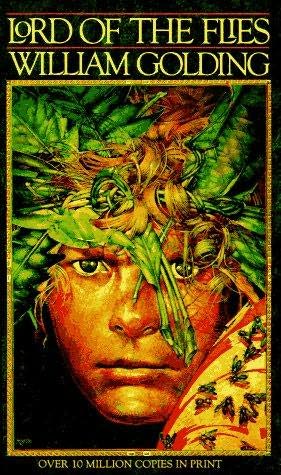
Review #8 Lord of the Flies

Golding, William. Lord of the Flies. New York: Penguin, 2003. Print.


Annotation:
When a plane crashes on an unknown tropical island containing a number of school-aged boys, in a world without rules and adults the boys begin to create their own society. Ralph and Jack, always at each other's throats, throw the group of boys into a tumultuous tribal and brutal society among themselves. Bloodthirsty and savage, the boys slowly begin to turn on their own.

Justification for Nomination (genre: Censored or Challenged, Allegorical)
Lord of the Flies is written by William Golding, a nobel prize winning author. It is narrated in third person and primarily follows the boys in the leadership roles, as well as Simon, the boy who discovers that the Lord of the Flies is not a beast but something that is inside all of them. Following the "tribe" and their self-imposed government you see the challenges and brutality that emerges from each boys natural killing instinct, surfaced by the struggles and situation they are put in. Without any proper leadership, their self-governing lifestyle is damaging to their weak minds and they began to try and pull rank on each other in a viscous and actually, bullying, manner. 

This is the second time I've read this book, the first time was during High School literature class, where we did not choose to read it but it was mandatory. It is extremely difficult to read books that are mandated upon you but for some reason this book is fascinating and I am unsure anyone believed it to be in any capacity boring. 

The end of the book is the most awe-inspiring, as they attempt to hunt and kill Ralph, one of their own, they smoke him out of the forest in an attempt to murder him on the beach. Ralph stumbles upon the beach and is resigned to his fate (in a way) when he runs smack dab into a military officer. The other boys come out onto the beach, ready to kill Ralph, and see him as well. In a humbling act of remorse and tragedy, all the boys being to cry. 

"And in the middle of
them, with filthy body, matted hair, and unwiped nose, Ralph wept for
the end of innocence, the darkness of man’s heart, and the fall through
the air of the true, wise friend called Piggy."

Tuesday, July 12, 2011

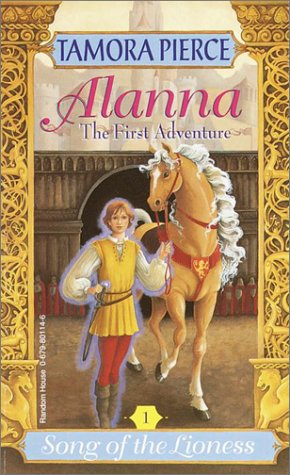
Review #7 Alanna: The First Adventure

Pierce, Tamora. Alanna: the First Adventure. New York: Random House, 1997. Print.

Annotation:
When Alanna and her twin brother Thom reach the age when their training must begin, they realize that without some intervention, their lives will end up as nightmares. Alanna and the village witch come up with a plan to ensure that she gets her dream -- to become a knight, and Thom instead gets to practice sorcery, as a privilege of being the younger brother. So Alanna begins her journey, can she hide the fact she is a girl from her fellow pages and squires? What kind of magic does she really possess?

Justification for Nomination (genre Fantasty):
Alanna is written by the great (in my opinion) fantasy novelist Tamora Pierce, and is the first in a quartet of books called the Song of the Lioness. I have read this book about four times and several sections more than that, because this book is the embodiment of what a tomboy wishes she could be. A magic girl who can pass as a page, and eventually become a knight? Alanna's magic sword Lightning, and her friendship with the King of Thieves and Jonathan the Prince entwine her into a journey filled in sorcery, physical anguish and triumph. I chose this book immediately upon finding out the genre because I knew that it held a special place.

There are four stages to becoming a knight in the king's palace, and therefore four books to align with Alanna's path to knighthood. There is also a tiny bit of romance hidden in this series as well, although it is not the primary objective of the book and is not prominent especially in the first one, which is the one nominated in this review. 

It is written in third person, and Alanna herself is the main character. The author lets you get close to Alanna's thoughts and feelings. You feel her determination and how let down she is when she loses her temper or a battle with a stronger person. It is exciting that she is able to hide her identity and realize her dream, and these are the kind of novels that make you realize that you could possibly realize your dream. That is why fantasy is such an amazing genre, and why this book is a perfect example of enough magic to make it impossible but enough realism to think you too could someday be a knight. 

Tuesday, July 5, 2011

Review #6 Blood and Chocolate

Klause, Annette Curtis. Blood and Chocolate. New York: Delacorte, 1997. Print.

Annotation:


Vivan is young, beautiful, smart and classy. When she paints a picture that is published in the school newspaper depicting herself and her pack as wolves, she tumbles into a relationship with a boy who she believes could be the one human to enjoy her secret. She is warned to stay away from him by the rest of her pack...but being the rebellious teen she is, she doesn't listen. Will Vivian and her kind human Aiden be able to withstand the pack? Will Vivian be forced to reveal her secret of being a wolf-shifter?


Justification for Nomination (genre Supernatural/Horror):

Blood and Chocolate, which won the 1998 YALSA Award for Best Books for Young Adults, is a very easy read that keeps you entranced from the tragic beginning to the triumphant and shocking end. It is written in third person, from the perspective of Vivian, a young and beautiful shifter who grows restless dealing with the annoying young wolves her age. Although she is destined to choose a mate from one of her own, she rebels and meets a kind and gentle boy who seems to understand her. I really enjoyed this book, although I had almost no prior fascination with the genre. I found it even easier to read than some of the books I bought on my own accord, and really enjoyed the ease in which I fit into the life of Vivian and her family. Although the reader might wish Vivian was a little more mature at times, as an adult it is harder to shrink into teen's shoes and think that perhaps this behavior is normal for them. I could relate to Vivian and many levels though, generically, and her strong female character presence in the book made it incredibly alluring to read when she was with one of the male characters.

The plot in this book takes several turns, and I think someone can really enjoy this book for that reason. It was not your typical story and without reading the book or a spoiler you will be unsure of how it ends.

Tuesday, June 28, 2011

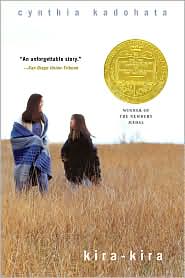
Review #5 Kira-Kira


Kadohata, Cynthia. Kira-kira. New York: Atheneum for Young Readers, 2004. Print.


Annotation:

Kira-Kira is a tragic yet touching story of a young Asian American girl and her and her families' struggle in America during the 1950's. Winner of the 2005 Newbery Medal, Cynthia Kadohata weaves a tale of bravery and trust as we watch Katie idolize and finally lose her older sister Lynn.


Justification for Nomination (genre Multicultural):

Kira-Kira is a nice change of pace because it is specifically meant for young teens, so the read is easy and fun. You feel like you are gaining a little bit of extra knowledge when you read it because of how the author sprinkles in Japanese words so you can learn them along the way. The reader feels compassion for Katie and people with siblings surely feel a connection with Katie and Lynn as sisters. It is very interesting reading about Japanese people in America in the 1950's because this was probably a hard time to be Japanese-American. Katie explains how they would approach a restaurant where there was segregation, and without knowing where they should sit, they would order to-go.

Kira-Kira is written in first person from the viewpoint of Katie, who is 11 years old at the end of the book. I think the author lets you get somewhat close to Katie but because she is a little girl her thoughts are plain and straightforward. Katie is not manipulative or cruel, or have evil thoughts. She thinks about how her father loving her mother makes her feel loved, and how she can eat as many candies as she wants because her teeth are baby teeth and will fall out anyway.

Overall the book was endearing, and definitely targeted for a younger audience. I think it was a bit sad but I enjoyed reading and learning some cultural tips about Japan along the way.

Friday, June 17, 2011

Review #4 Helmet For My Pillow: From Parris Island to the Pacific

Leckie, Robert. Helmet for My Pillow: from Parris Island to the Pacific : a Young Marine's Stirring Account of Combat in World War II. New York: Bantam, 2010. Print.


Annotation:

Truly compelling, Helmet for my Pillow is an intimate look at one young Marine's life from his training to his survival of some of the most epic battles in the Pacific Theater of World War II. Robert "Lucky" Leckie recalls the hardships of himself and his fellow Marines, and recounts in haunting detail the price they paid for serving their country when they were still only teenagers.


Justification for Nomination:

Set in the genre of General Non-Fiction, this book written by Robert Leckie is a heartfelt and incredible look into his time serving in the First Marine Corps of the United States. Helmet For My Pillow has been an impact on the motion picture industry as well, and is a big part of Tom Hank's HBO critically acclaimed mini-series "The Pacific" where Robert Leckie plays a main part in the story line as the first main character they introduce. The Pacific part of WWII is the less covered but just as amazing part of WWII, whereas many stories focus on Europe during that period, the fighting in the Pacific area was just as brutal if not more so. In Helmet For My Pillow the reader really feels the angst that Leckie goes through, it is first person and you travel with Leckie through his training and through the many battles he fought in and amazingly enough survived. The captivating part of the story isn't the combat, it's the hardships that Leckie and his fellow marines were forced to endure. Robert Leckie gives the full account of the malaria, dysentery and mental anguish he and his comrades dealt with while trying to stay positive. In the horrible conditions of Guadalcanal, the reader experiences alongside Leckie the foot sores and the sorrowful feeling of being "expendable" by the military. One of the most moving parts of this book is when Leckie's new commander moves him from H Company where his only friends are to the dispirited E Company, much to his humiliation and agony, and the reader really feels that the soldiers who are fighting an impenetrable force of Japanese are also cruelly fighting their own institution.

One moment which was endearing and also heartwarming was the uncertainty Leckie and his close friends encountered over whether or not their worth was even noticed by the United States, did their fellow American’s even know Guadalcanal even existed? This is one point where the book that was part of the material for the HBO miniseries The Pacific was entwined almost word-for-word. When they are pulled aboard a naval ship, too weak to even board the ship under their own strength, Leckie and his friends drink a cup of coveted coffee and speak with a seaman. The reader and the soldiers alike are taken aback and humbled when the naval man offers the fact that “Everyone has heard of Guadalcanal. You guys are heroes back home.”

One of the many things I can appreciate about the accounts taken by the men in The Pacific miniseries – Robert Leckie included – is the ability they have to retell the story without sounding unpatriotic or unappreciative. They recount the stories of being starved, shot at, dehydrated, and not having enough supplies to keep them healthy yet they speak of the Marine Corps as a thing of such pride and grace. They take it all in stride even on the brink of insanity, and do their best to make the most of their situation. Most of the men that Robert Leckie was friends with as well as himself were volunteers; they headed into WWII without even knowledge of if they would end up in Germany or in the Philippines.

Overall I thought this book was both compelling and engaging. The hardships and the triumphs are felt by both the soldiers and reader, and the injustice of the circumstances yet the heroism and courage of the men make it both infuriating and joyous. I wonder if this was a difficult piece to recall for the author, and by the way he distances himself from some of the men who were killed by referring to them loosely by their location or nationality makes me feel like this was an incredible feat not only to write a memoir about such a trying time but also to remember it all. I would recommend The Pacific miniseries to anyone as well as this book, and I am looking forward to reading other books written by Leckie as well as his comrades who have also written some pieces about the foreboding war fought in the Pacific.